
Project results
From stakeholder needs to practical learning resources
SHaKE was created to support the transition towards more efficient, flexible and sustainable district heating and cooling systems by bringing up-to-date knowledge into both higher education and professional training.
The project brought together universities from Hungary, France and Spain, combining their different areas of expertise in district energy. From the beginning, the aim was not simply to produce new teaching materials, but to develop resources that respond to real educational and professional needs, can be tested in practice, and remain freely available for further use.
By the end of the project, this work resulted in a comprehensive multilingual learning package, a dedicated intensive course for professionals, and a series of international courses, pilots and mobility activities through which the materials were tested and refined.
 Starting with the needs of the sector
Before developing the learning materials, the SHaKE partners looked at what future district energy professionals actually need to know.
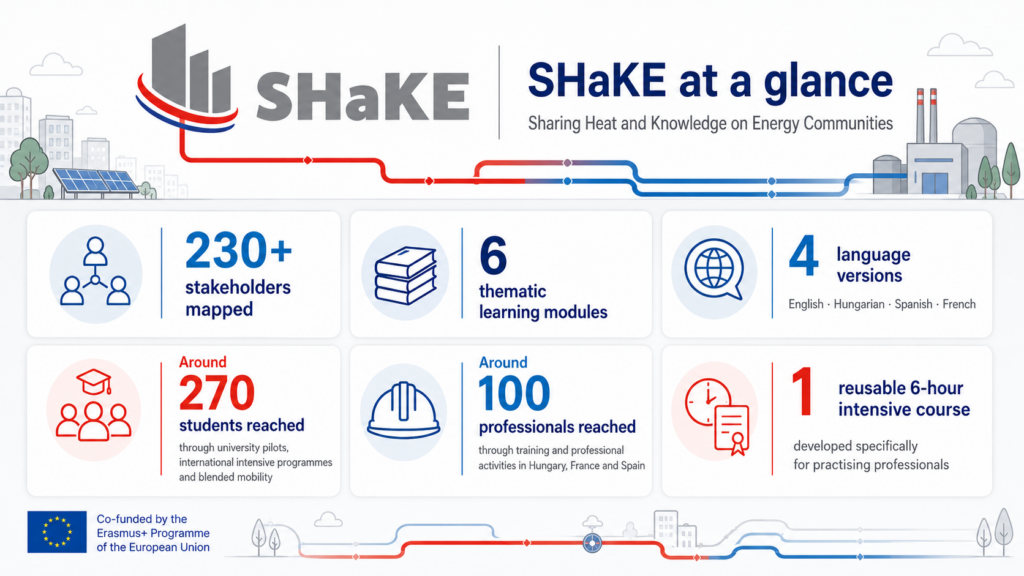
More than 230 stakeholders were identified across the three partner countries, including district heating and cooling organisations, engineering and professional associations, energy companies, designers, researchers and educators.
A multilingual stakeholder survey then explored the importance of a broad range of skills and competences related to modern district energy. 36 stakeholders completed the full survey, and the results were complemented by interviews and further professional feedback.
This provided an important starting point for the educational work. The findings helped the partnership decide where greater emphasis was needed and ensured that the SHaKE materials reflected not only academic expertise, but also the changing needs of the energy sector.
A complete learning package for higher education
The main educational result of SHaKE is a six-module learning package on modern district heating and cooling.
Together, the modules cover the development of district energy systems and energy communities; heat and cold demand; heat production and renewable energy integration; waste heat and heat pumps; district cooling; advanced systems, optimisation and digital tools; and the refurbishment of existing district heating systems.
The package goes beyond conventional presentation slides. The modules combine detailed learning materials with presentations, practical exercises, case studies, question banks, self-check quizzes and other resources that lecturers can use as complete teaching units or integrate selectively into existing courses.
The materials were developed jointly by the three partner universities using a common structure and were reviewed, piloted and refined throughout the project.
Most importantly, the complete SHaKE Higher Education Learning Package is openly available in four languages: English, Hungarian, Spanish and French.
📚 Explore the full SHaKE Learning Materials
The complete package can be viewed and downloaded from the Learning Materials section of this website.
Learning by testing, applying and improving
SHaKE materials were not developed only at a desk. During the project, selected content was introduced into university courses and tested repeatedly with students in different learning settings.
International ATHENS–EELISA intensive programmes provided an especially useful testing environment. Further intensive programmes and pilot activities continued during the final project year. By the end of the project, around 270 students had engaged with SHaKE materials through university courses, international intensive programmes and blended mobility activities.
These learning environments made it possible to combine technical content with teamwork, applied tasks, case studies, discussions and site visits. Student feedback was used throughout the process to improve both the materials and the way they could be taught.
International learning in practice
One of the project’s key international learning activities was the SHaKE Blended Mobility Week in Paris, hosted by Mines Paris – PSL in March 2026.
The programme brought together 13 students from the three partner universities for an intensive week focused on district heating and cooling in the energy transition.
Lectures were combined with international teamwork, an applied district energy task and a technical site visit, giving participants an opportunity to connect the theoretical content of SHaKE with real systems and professional practice.
The mobility week also provided valuable feedback on how well the learning materials work across different institutions and educational backgrounds.
🌍 Explore the SHaKE Blended Mobility Week
From university learning to professional practice
A second major educational result of SHaKE is the Professional Intensive Course, developed for practising engineers and other professionals who already have a basic understanding of energy and building systems.
Rather than reproducing the complete university course, the professional package selects the content most relevant to current practice and brings it together in a proposed six-hour intensive training programme.
Its central resource is the Professional Course Reader, which includes guidance on using the materials, a suggested course structure and the theoretical and technical content selected from the six SHaKE modules. Condensed module presentations and self-check resources support delivery of the course.
During the project, around 100 professionals were reached through training and professional activities across Hungary, France and Spain, helping to connect the project results directly with the sector they were designed to support.
🎓 Explore the Training for Professionals
The Course Reader and supporting training materials can be viewed and downloaded from the Training for Professionals section of this website.
Designed to be used beyond SHaKE
An important objective throughout the project was to create materials that would remain useful beyond the three partner universities and beyond the funded project period.
The learning resources therefore follow a modular structure. Lecturers can adopt a complete module or select individual topics, exercises and assessment resources. Professional organisations can use the full intensive programme or adapt parts of it to shorter continuing professional development activities.
Quality was supported through partner review, stakeholder input, pilot teaching and feedback from students and professionals. This combination helped ensure that the final materials are not only academically sound, but also practical, transferable and reusable.
All core educational resources are provided through the project website with open access.
Continuing the SHaKE journey
SHaKE has brought together stakeholder knowledge, academic expertise, international cooperation and practical testing to create an educational resource that can continue to evolve with the district energy sector.
The multilingual higher education package can support future university teaching. The professional course provides a ready-to-use basis for continuing education. And the international learning activities demonstrated how the same materials can be applied across countries, institutions and learning contexts.
The funded project may have reached its end, but its main results are designed to remain in use.