Blended Mobility Week in Paris
District Heating and Cooling for Energy Transition
Mines Paris – PSL, Paris | 2–6 March 2026
The SHaKE Blended Mobility Week took place at Mines Paris – PSL between 2 and 6 March 2026, bringing together students, lecturers and project partners from the three SHaKE partner universities: Budapest University of Technology and Economics (BME, Hungary), Mines Paris – PSL (France) and Universitat Jaume I (UJI, Spain).
The intensive course, titled “District Heating and Cooling for Energy Transition”, was organised as part of Work Package 4 of the SHaKE project. Its main objective was to provide students with an international, practice-oriented learning experience in the field of sustainable district heating and cooling, while also supporting the testing and further development of the SHaKE educational materials.
The mobility week involved 13 students from the three partner universities: 3 students from BME, 6 students from Mines Paris – PSL and 4 students from UJI. The academic programme was delivered by the SHaKE teaching team, with contributions from all three partner institutions. The course programme included teaching contributions from Balázs Bokor from BME, Adrián Mota Babiloni from UJI, and Antoine Fabre and Pascal Stabat from Mines Paris – PSL.
Aim of the mobility week
The Blended Mobility Week was designed to help students understand the role of district heating and cooling networks in the energy transition. The programme supported the broader SHaKE objective of developing innovative educational materials for university students and professionals in district heating and cooling technologies.
The mobility activity also created a forum for knowledge transfer, cooperation and experience exchange between the participating technical universities. By working together in an international setting, students were able to broaden their technical knowledge, compare different national and institutional perspectives, and build professional connections in the field of sustainable district energy.
The course aimed to help students understand the context and challenges of heating and cooling networks in decarbonisation strategies, apply energy engineering knowledge to the design of heating and cooling networks, analyse technological options including new technologies, and assess the energy and environmental performance of district energy systems.
Programme and learning activities
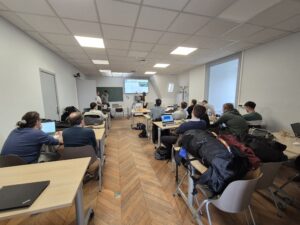
During the week, students followed an intensive technical programme combining lectures, applied project work, group discussions and a technical visit.
The course opened with a general introduction to the SHaKE project and to the role of heating and cooling networks in the energy transition. The following sessions covered the analysis of heating and cooling demand, distribution concepts and methods, heat generation technologies, renewable energy integration, heat pumps, cooling solutions, network types and sizing, and digital and cartographic tools applied to district heating and cooling networks.
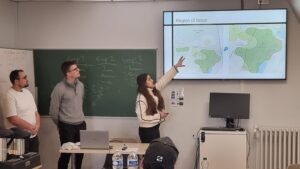
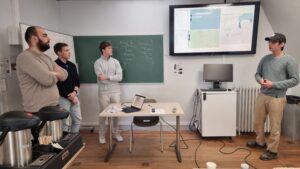
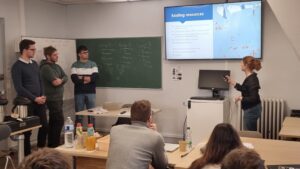
A strong emphasis was placed on project-based learning. Students worked in international teams on a district heating and cooling network design task, applying the concepts introduced during the lectures. The project assignment required them to analyse a given district area, consider possible network architectures and technological choices, and present their proposed solution at the end of the week.
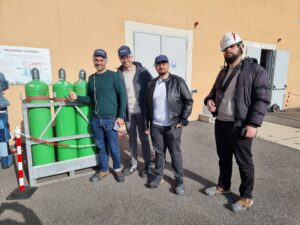
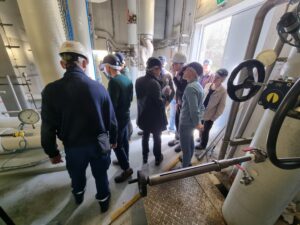
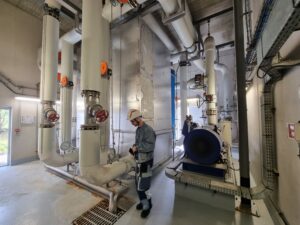
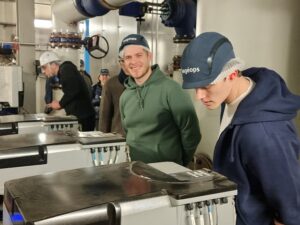
One of the highlights of the programme was the technical visit to a district heating and cooling network in Bagneux, where students could connect the theoretical content of the course with real-life infrastructure and operational practice. The visit was especially valuable in demonstrating the practical implementation of geothermal and district energy solutions in an urban context.
The week concluded with oral presentations of the student projects, providing an opportunity for the international teams to present their design approaches, justify their technical decisions and receive feedback from the teaching team.
Social and networking programme
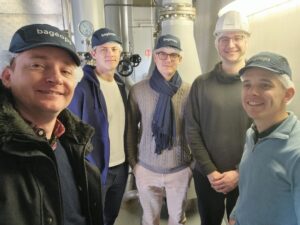
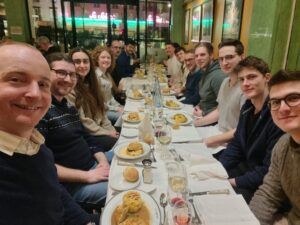
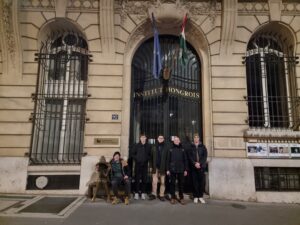
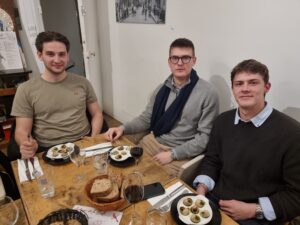
In addition to the academic programme, the mobility week included social and networking elements that supported the international learning experience. The programme included a Paris tour, a welcome dinner, a SHaKE partner dinner and a closure dinner.
These informal parts of the week helped students and teachers from the three countries get to know each other, discuss their academic and professional backgrounds, and strengthen cooperation within the SHaKE partnership.
Feedback and outcomes
Student feedback confirmed the value of combining lectures, project work and a technical visit. Students particularly appreciated the Bagneux technical visit, the opportunity to work in international teams, and the connection between theoretical concepts and real-life district heating and cooling systems. Several students highlighted that the week helped them better understand the feasibility, environmental impact and practical design aspects of district energy networks.
The Blended Mobility Week also contributed directly to the quality assurance and further development of the SHaKE learning materials. The course allowed the partners to test selected content with students from different educational backgrounds and collect feedback on the clarity, structure, applicability and practical relevance of the material.
Overall, the Paris mobility week successfully combined technical learning, international cooperation, project-based teamwork and professional networking, fully supporting the SHaKE project’s mission to share heat and knowledge on energy communities.